Disc Stack Centrifuge
Disc stack centrifuge, also known as disk stack centrifuge, disc separator or disc bowl centrifuge, features a series of conical discs that splitting centrifugation space into thin layers. The disc stacks increase the surface settling area which speeds up the separation process.
The disc stack centrifuge is used to remove solids phase from liquid, or to separate two liquid phases from each other by means of an enormously high centrifugal force, which is higher than 10,000g in most cases. The denser solids or liquids which are subjected to these forces move outwards towards the rotating bowl wall while the less dense fluids move towards the centre.
Different disc stack designs, arrangements and shapes are used for different processes depending on the type of feed present. The concentrated denser solid or liquid is then removed continuously, manually or intermittently, depending on the design of the bowl.
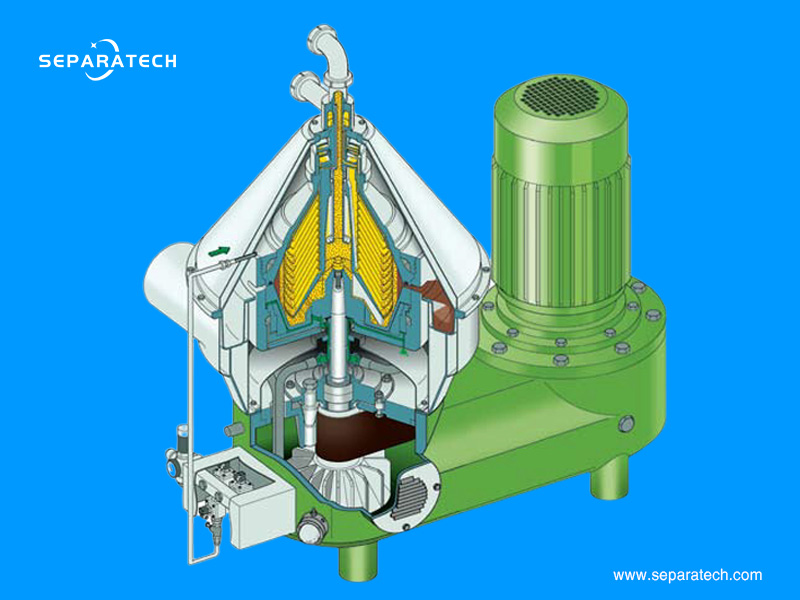
The SEPARATECH disc stack centrifuge represents the absolute cutting edge of high-speed vertical separation technology, engineered to deliver exceptional liquid-liquid-solid and liquid-solid separation under extreme gravitational fields. Often referred to as a conical disc separator, our heavy-duty disc stack centrifuge series utilizes a dense stack of conical discs to drastically expand the effective clarification area within a highly compact physical footprint. By generating centrifugal forces exceeding 10,000G, these automated vertical separators excel at isolating ultra-fine suspended solids from process streams and breaking highly stubborn liquid-liquid emulsions. Whether deployed in biotechnology, food and beverage processing, chemical manufacturing, or marine fuel conditioning, SEPARATECH delivers uncompromised separation clarity, maximizing product yield while guaranteeing continuous, uninterrupted plant automation.
Working Principle of Conical Disc Stack Separation
The operating superiority of an industrial disc stack centrifuge lies in its unique geometric design, which splits a single processing stream into dozens of micro-layers to minimize sedimentation distance. The entire process executes continuously through four highly synchronized mechanical phases:
- Hydro-Hermetic Material Feed: The raw process liquid enters the high-speed rotating vertical bowl assembly through a stationary, centrally located feed pipe. To prevent intense hydraulic shear stress from tearing apart delicate biological cells or sensitive polymer chains, the slurry undergoes smooth, non-turbulent acceleration through a specialized bottom-fed inlet distributor. This gentle acceleration preserves particle integrity and ensures optimal settlement readiness.
- Dynamic Centrifugal Stratification: Once inside the rotating bowl, the liquid enters the intricate disc stack—a series of dozens of conical discs spaced fractions of a millimeter apart. Under intense centripetal acceleration, the heavier phase (solid particles or heavy liquid) is flung outward against the inner underside of each disc, sliding rapidly down the conical surface toward the periphery of the bowl. Concurrently, the light liquid phase tracks inward along the top surface of the discs toward the center spindle.
- Dual-Phase Liquid Discharge via Centripetal Pumps: The separated liquid phases travel upward to the top of the bowl chamber. The clarified light liquid phase and heavy liquid phase are intercepted by integrated, stationary centripetal pumps (paring discs). These specialized impellers convert the kinetic energy of the rotating liquid into pressure, discharging both fluids smoothly under a completely air-free, pressurized state to prevent product foaming or oxidation.
- Automated Solid Ejection (Self-Cleaning Matrix): Depending on your specific process solids concentration, SEPARATECH offers both solid-retaining bowls (for manual cleaning of extremely low solid content) and advanced self-cleaning, periodic-discharge bowls. In a self-cleaning disc stack centrifuge, an internal hydraulic operating system drops the sliding piston for a fraction of a second at pre-set intervals, blasting the accumulated heavy solids out through peripheral discharge ports without stopping the machine.
The disc stack centrifuge is very suitable for clarifying, concentrating, purifying products. Self-cleaning bowl, solids retaining bowl, nozzle bowl and chamber bowl are the most common design.
-
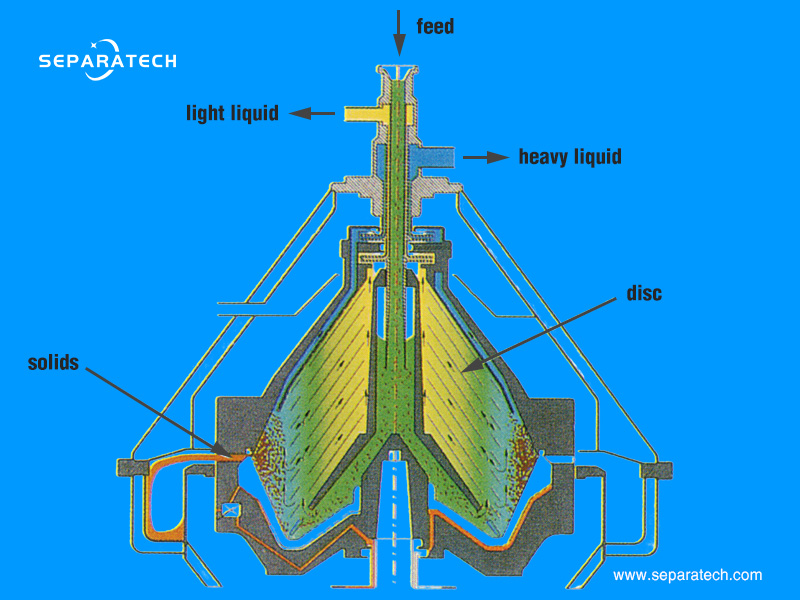
Self-Cleaning Disc Stack Centrifuge
Continuous self-cleaning disc stack centrifuge systems for high-purity separation. Features automated hydraulic sludge ejection and hermetic feeding to maximize processing efficiency and eliminate operational downtime.
-
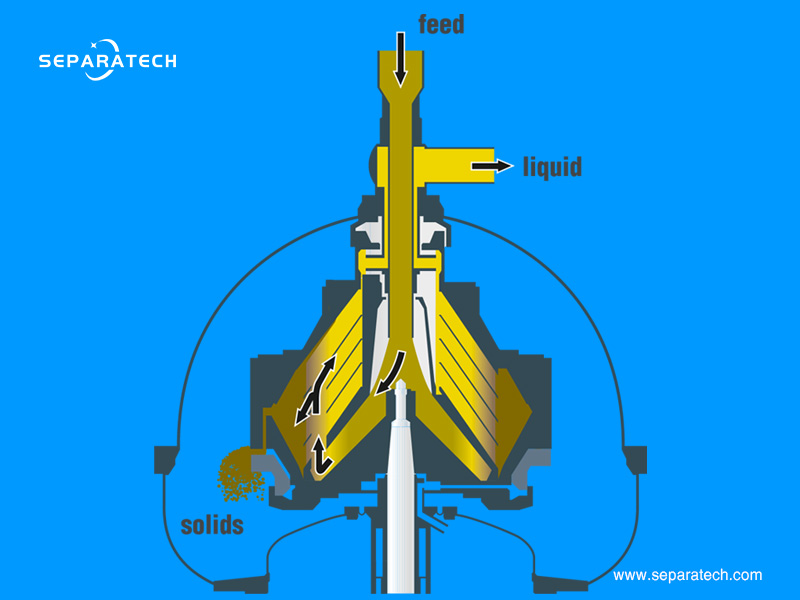
Continuous Nozzle Disc Centrifuge
Continuous nozzle disc centrifuge systems designed for high-solids processing. Features instant nozzle sediment discharge and concentrate recirculation to optimize slurry thickening while preventing downtime in global industrial plants.
-
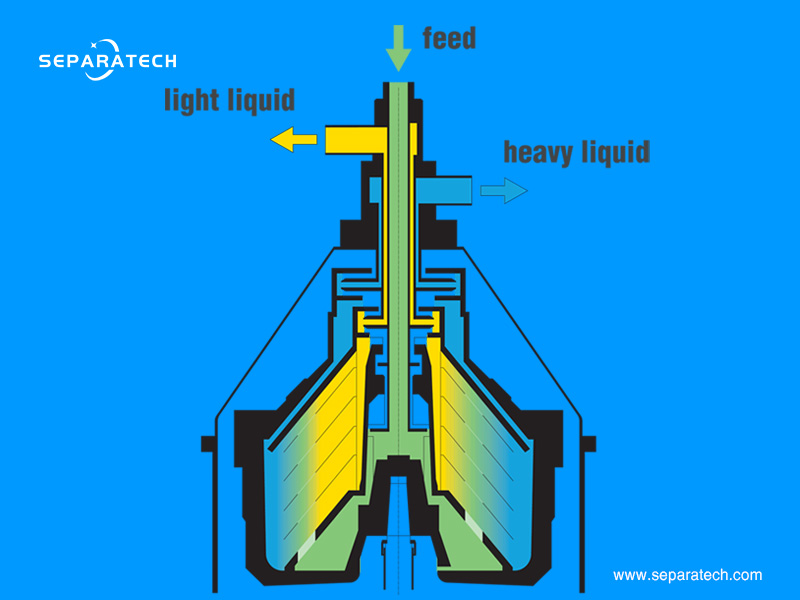
Manual Discharge Disc Centrifuge
Manual discharge disc centrifuge systems designed for low-solids processing. Features a solid-retaining bowl and precise liquid phase clarity to optimize product purity while preventing loss in global industrial plants.
-
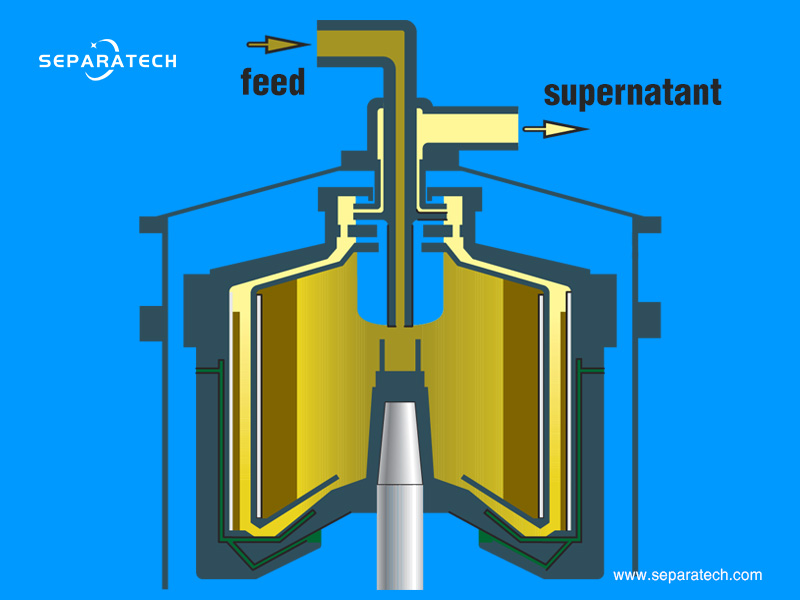
Multi-Chamber Bowl Centrifuge
Multi-Chamber Bowl Centrifuge is solid-bowl centrifuge with annular inserts, which divide the bowl separation chamber into several concentric annular chambers. It is mainly used for clarifying liquid, as well as recovery solids from suspensions.
Core Process Configurations: Clarifier vs. Purifier vs. Concentrator
To handle varying fluid ratios and diverse industrial separation objectives, every SEPARATECH disc stack centrifuge can be configured into three primary mechanical processing arrangements:
- The Clarifier Configuration (Liquid-Solid Separation): Optimized for removing fine suspended solids from a single liquid phase. The bowl is sealed for liquid-solid separation, maximizing hydraulic retention time inside the disc stack to capture sub-micron particles and deliver an exceptionally clear centrate.
- The Purifier Configuration (Liquid-Liquid-Solid – Water Removal): Designed to separate two immiscible liquids of different densities while simultaneously removing a small fraction of solids, where the primary objective is to purify the light liquid phase (e.g., removing trace water from marine diesel oil or vegetable oil). A precise regulating ring (gravity disc) is matched to the specific gravity difference to maintain a perfect separation interface.
- The Concentrator Configuration (Liquid-Liquid-Solid – Oil Removal): Conversely, the concentrator configuration is applied when the heavy liquid phase represents the primary product, and the machine must extract a small fraction of a light liquid contaminant (e.g., recovering trace essential oils or removing light grease from water-dominant process streams).
Structural Blueprint and Technical Architecture
To survive years of continuous 24/7 high-speed rotation without mechanical fatigue, the SEPARATECH disc stack centrifuge is engineered using exceptional metallurgy and cutting-edge mechanical balance:
- Centrifugally Cast Duplex Stainless Steel Bowl: The entire high-load rotating bowl assembly is manufactured from high-tensile duplex stainless steel via premium centrifugal casting methods. This ensures flawless structural integrity, zero micro-porosity, and absolute resistance to localized stress corrosion and pitting under extreme centripetal forces.
- Vibration-Absorbing Vertical Drive Matrix: Supported by top-tier, precision-matched bearings, the vertical spindle assembly incorporates a highly resilient, vibration-isolated spring suspension system. This industrial architecture absorbs transient imbalances smoothly, ensuring ultra-low noise levels and minimizing mechanical wear on the drive gear.
- Advanced Variable Frequency Smart Drives (VFD): Driven by premium high-efficiency motors controlled by a fully responsive VFD electronic system. This allows for controlled, smooth belt-driven or direct-drive acceleration, reducing start-up current spikes and allowing operator field adjustment of rotational speeds based on specific material processing requirements.
- Hermetic Air-Sealing and Nitrogen Blanketing: For volatile chemical processes, pharmaceutical extractions, or oxygen-sensitive food products, SEPARATECH provides specialized hermetically sealed gas-tight frames capable of supporting a continuous nitrogen blanket, guaranteeing complete process safety.
Strategic Economic Advantages of High-Speed Separators
Integrating a SEPARATECH disc stack centrifuge into your plant architecture offers major operational and financial performance benefits compared to traditional static settling tanks, filter presses, or standard decanters:
- Unmatched Product Purity and Clarity: The massive G-force and immense disc separation surface area enable the extraction of microscopic particles down to 0.5 microns, achieving clarity levels unattainable by horizontal sedimentation machinery.
- Elimination of Consumable Filter Media: Operates as a purely mechanical separation engine, completely eliminating the high recurring costs, maintenance downtime, and environmental disposal liabilities associated with filter cartridges, bags, or diatomaceous earth.
- Minimal Footprint, High-Volume Output: Thanks to the concentrated vertical design of the conical disc stack, these systems process immense hourly fluid volumes within a fraction of the floor space required by alternative separation equipment.
- Continuous Intelligent Plant Automation: Equipped with intelligent PLC control panels that constantly monitor bearing temperatures, vibration frequencies, and hydraulic discharge pressures, facilitating fully unattended 24/7 operations.
Fluid Shear Mitigation and Emulsion Breaking Dynamics
Achieving optimal performance with a disc stack centrifuge requires an expert understanding of interfacial tension and fluid shear mitigation. When handling complex emulsions, sudden turbulent velocity changes can cause droplet breaking, creating micro-emulsions that severely degrade separation efficiency. SEPARATECH addresses this by refining the internal bowl hydrodynamics, ensuring the liquid mixture undergoes a smooth acceleration curve before entering the distribution holes of the disc stack. Additionally, by fine-tuning back-pressure valves on the clean phase outlets, operators can move the fluid separation interface precisely within the disc stack zone, allowing the machine to easily handle fluctuating oil-to-water ratios while securing top-tier phase purity and exceptional solid dryness.
Custom Engineering of Disc Stack Centrifuge Systems
No two high-speed separation or purification challenges are identical. SEPARATECH’s dedicated team of process engineers can fully customize the disc spacing angles, caulking strip profiles, bowl discharge volumes, and frame geometries to align perfectly with your specific fluid viscosity, density differential, and solids loading parameters.
Contact SEPARATECH today to collaborate with our vertical high-speed separation specialists. We will provide a comprehensive process evaluation, laboratory pilot testing protocols, and a fully optimized disc stack centrifuge technical proposal designed to maximize your production throughput and processing efficiency worldwide.