Self-Cleaning Disc Stack Centrifuge
Self-Cleaning Disc Stack Centrifuge with self-cleaning bowl, is able to periodically discharge the separated solids at full speed. it is mainly used for liquid/liquid/solid continuous separation.
Self-Cleaning Disk Separator is also equipped with a stack of conical disks to create a large equivalent clarification area within a relatively small bowl volume. Self-Cleaning Disk Separator. For solids discharge, several solids discharge ports are spaced evenly around the bowl periphery. These ports are opened and closed by means of a movable sliding piston located in the bowl bottom. The opening mechanism is actuated hydraulically. Water is normally used as a control medium; in special cases, low-viscous organic fluids can also be used.
This opening mechanism enables both partial ejections and total ejections. Total ejections involve discharging the entire contents of the bowl with closed feed valve. In the case of a partial ejection, by contrast, only part of the bowl contents is ejected with open feed valve.
As with solids retaining separator, the Self-Cleaning Disk Stack Centrifuge is likewise available as versions for clarification and separation, even concentration.
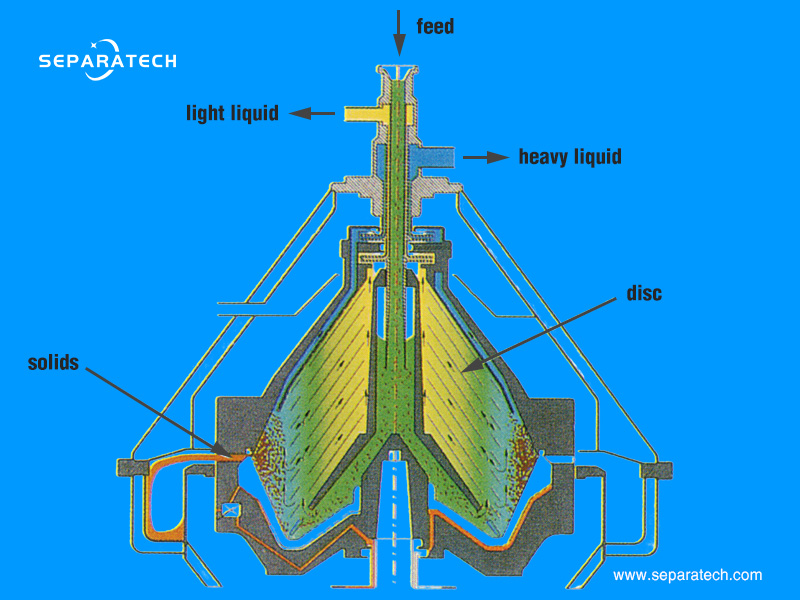
The SEPARATECH self-cleaning disc stack centrifuge represents the pinnacle of autonomous, high-speed vertical separation technology, engineered to deliver relentless 24/7 liquid-liquid-solid and liquid-solid purification without operational interruption. Unlike manual solid-retaining bowl separators that require frequent shutdown, mechanical disassembly, and hands-on maintenance, our advanced self-cleaning disc stack centrifuge series integrates an intelligent hydraulic shooting mechanism. This feature enables the machine to eject accumulated solids autonomously at full rotational speeds within milliseconds. By exerting centrifugal forces that exceed 10,000 G combined with an expanded settling surface area via a precision conical disc stack, SEPARATECH provides heavy industries with a highly reliable, high-throughput automated solution designed to eliminate plant downtime, maximize fluid phase purity, and guarantee uncompromised process safety.
Hydro-Dynamic Working Principle of Self-Cleaning Sedimentation
The continuous operating efficiency of an industrial self-cleaning disc stack centrifuge depends on the perfect balance between high-speed centrifugal stratification and precise hydraulic timing. The feed slurry undergoes three distinct mechanical phases inside the rotating vertical bowl assembly:
- Non-Turbulent Hermetic Feeding: The raw multi-phase suspension is introduced coaxially via a stationary inlet pipe into the center of the rotating bowl. Using an advanced, bottom-fed hermetic inlet distributor, the liquid accelerates smoothly to match the high bowl speed. This critical fluid management completely mitigates hydraulic shear stress, preventing the fragmentation of delicate biological cultures, fat globules, or complex chemical polymers.
- High-Speed Disc Stratification: The accelerated liquid flows upward through the intricate conical disc stack. Under intense centripetal acceleration, the heavy suspended solids are flung outward against the underside of each conical disc, sliding rapidly down the surface to accumulate in the outer V-shaped sediment holding space of the bowl. Concurrently, the light and heavy liquid phases track inward along the top surface of the discs, separating by density.
- Continuous Pressurized Liquid Discharge: The clarified liquid phases reach the top of the bowl chamber, where integrated stationary centripetal pumps (paring discs) intercept them. These high-precision impellers convert the liquid’s kinetic energy into pressurized force, discharging the fluids smoothly out of the self-cleaning disc stack centrifuge in a completely air-free state, which effectively prevents product foaming, cross-contamination, and oxidation.
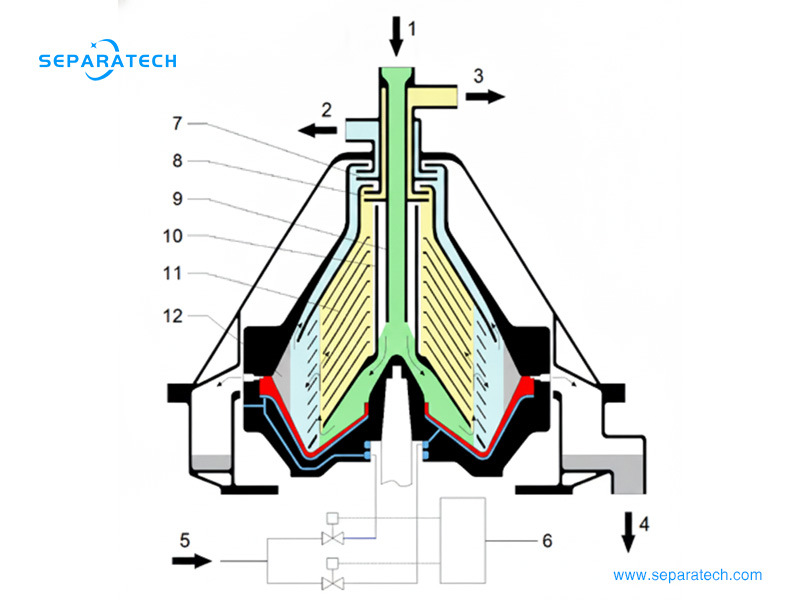
The Self-Cleaning Disc Stack Centrifuge is equipped with a self-cleaning disc-type bowl with hydraulically operated piston for opening and closing the sediment ejection ports of the bowl.
The product (1) flows into the bowl through inlet (9) and is separated in disc stack (11) into a light and heavy liquid phase. Both liquid phases are discharged without foam and under pressure by means of centripetal pumps (7 and 8) through outlets (3 and 2). The separated solids accumulate in the sediment holding space (12) and are periodically ejected through ports. Solids (4) leave centrifuge under gravity. The ejection process is controlled by a control unit (6). Operating water (5) consumption for pulse, like closing / opening water supply is additionally required for each ejection.
The Automated Piston Mechanism & Shooting Technology
The definitive mechanical advantage of a SEPARATECH self-cleaning disc stack centrifuge lies within its automated solids ejection sequence, engineered to execute at precise process intervals:
- The Hydraulic Sliding Piston: The bottom of the sediment holding space is sealed by a robust, hydraulically operated sliding piston. During normal separation operations, internal operating water pressure forces this piston upward, sealing the peripheral solid discharge ports tightly.
- Partial vs. Total Discharge Matrix: Controlled by a centralized PLC, the operating water loop reverses for a fraction of a second. The sliding piston drops instantly, opening the peripheral ports to eject the compacted solids. Operators can program a Partial Discharge (ejecting only the concentrated sludge while keeping the liquid pool intact) or a Total Discharge (clearing the entire bowl volume during intensive flushing cycles) based on specific solids characteristics.
- Millisecond Action Velocity: The entire opening and closing sequence executes in less than 1/10th of a second at full operational speed. Centrifugal feed flow never stops, ensuring a completely seamless, continuous process stream and maximum plant productivity.
- Fully Integrated Cleaning-in-Place (CIP) Protocols: Beyond dynamic solids ejection, the SEPARATECH self-cleaning disc stack centrifuge architecture is engineered to support fully automated, multi-stage Cleaning-in-Place (CIP) cycles without requiring structural dismantling. During a scheduled chemical wash, the internal hydro-hermetic flow paths allow targeted routing of caustic detergents, acid rinses, and hot sanitizing water through the rotating bowl assembly and complex disc stack crevices at full or reduced processing speeds. By utilizing the machine’s own immense centripetal pumping system alongside programmed hydraulic partial discharges, the system vigorously flushes out stubborn organic residues, scaling formations, and microscopic bio-films from the sediment holding space. This automated CIP integration guarantees strict sanitary compliance, completely eliminates manual scrubbing labor, and maintains maximum processing uptime for cross-contamination-free production lines.
Structural Blueprint and Technical Architecture
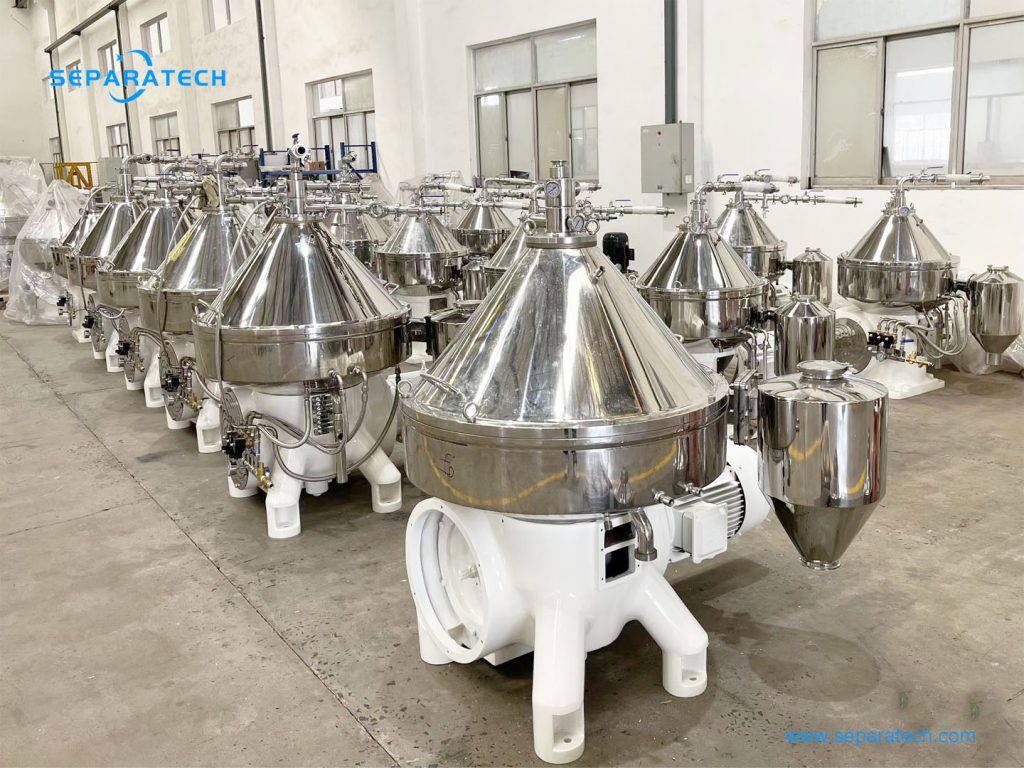
To survive years of high-speed vertical rotation and intense hydraulic shooting forces without structural fatigue, the SEPARATECH self-cleaning disc stack centrifuge is manufactured using premium metallurgical and mechanical components:
- Centrifugally Cast Duplex Stainless Steel Bowl: The entire rotating bowl assembly is manufactured from premium high-tensile duplex stainless steel to comply with international high-grade duplex stainless steel standards. This guarantees zero structural deformation and absolute resistance to localized pitting or stress corrosion.
- Vibration-Absorbing Flexible Spindle Assembly: Supported by top-tier precision-matched bearings, the vertical drive spindle incorporates a highly resilient, vibration-isolated spring suspension system. This heavy-duty design dampens transient imbalances during rapid sludge ejection cycles, minimizing component wear.
- Smart Variable Frequency Drive (VFD) Electronics: Driven by high-efficiency motors paired with an advanced VFD control matrix. This architecture provides smooth, controlled acceleration curves that reduce start-up current spikes and allow field adjustments of G-force settings to match varying fluid characteristics.
- Gas-Tight Frame and Explosion-Proof Options: For volatile chemical processes, solvent extractions, or oxygen-sensitive food manufacturing, SEPARATECH provides fully hermetic, ATEX-certified systems supporting a continuous nitrogen blanket.
Critical Applications Across Global Processing Sectors
The robust solids handling capability and automated operation of our self-cleaning disc stack centrifuge series make it the primary equipment choice across diverse industrial manufacturing sectors:
- Biotechnology & Pharmaceutical Harvesting: Clarification of fermentation broths, separation of biomass, recovery of extracellular proteins, and isolation of delicate mammalian cell cultures.
- Chemical & Petrochemical Industries: Processing of industrial wastewater, separation of organic solvents, cleaning of catalyst wash water, and treatment of refinery slop oil emulsions.
- Food, Beverage & Bio-Oil Extraction: Clarification of fruit juices, separation of citrus oils, degumming and neutralizing of vegetable oils, and processing of bio-diesel washing lines.
- Marine & Power Plant Fuel Conditioning: High-speed purification of heavy fuel oil (HFO) and continuous dehydration of lubrication oils to protect large-bore diesel engines from catastrophic wear.
Advanced Control Variables of Self-Cleaning Disc Stack Centrifuge Systems
Maximizing the operational efficiency of a self-cleaning disc stack centrifuge requires a comprehensive understanding of internal settlement dynamics and interfacial tension. By using advanced fluid dynamics and settling velocities, our process engineers optimize the exact placement of distribution holes within the disc stack to ensure peak liquid-liquid-solid separation. Furthermore, fine-tuning the back-pressure valves on the clean phase outlets moves the separation line precisely within the disc stack zone. This capability allows the system to manage fluctuating solid concentrations and feed densities easily while maintaining excellent phase purity, exceptional cake dryness, and low polymer consumption.
Custom Engineering of Self-Cleaning Disc Stack Centrifuge Systems
No two industrial automation challenges feature identical particle size distributions or solids loading volumes. SEPARATECH’s dedicated team of process engineers can fully customize the disc spacing configurations, caulking strip dimensions, shooting water intervals, and frame geometeries to align perfectly with your specific material viscosity, density differentials, and corrosion challenges.
Contact SEPARATECH today to collaborate with our high-speed automated vertical separation specialists. We will provide a comprehensive process evaluation, laboratory pilot testing protocols, and a fully optimized self-cleaning disc stack centrifuge technical proposal designed to maximize your production yield and processing efficiency worldwide.