Classifying Decanter Centrifuge
The SEPARATECH classifying decanter centrifuge represents a highly specialized milestone in wet classification technology, engineered specifically for the continuous separation of suspended solid particles based on their physical size and specific gravity. Unlike standard two-phase dewatering centrifuges that aim for total solid recovery, our premium horizontal classifying decanter centrifuge utilizes highly controlled centrifugal forces to split fine and coarse particles into two distinct fractions. By dynamically isolating the desired micron-sized product from the oversize or undersize slurry, SEPARATECH provides global processing plants with an exceptionally robust, high-throughput automated solution designed to achieve precise cut points, maximize mineral purity, and optimize downstream processing efficiency.
Classification, the fractionation or separation of particles by size,could be considered as merely inefficient clarification. The cut, or desired classification, is adjusted by altering the classifying decanter centrifuge’s efficiency. This is most easily done by altering the feed rate or bowl speed of classifying decanter centrifuge. However, adjustment of pond depth or differential may. in certain circumstances, be used.
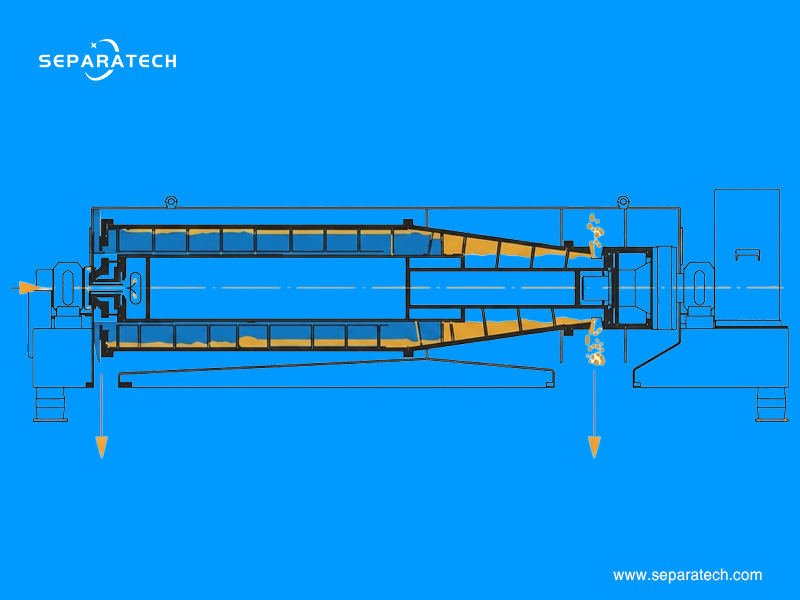
In some classification applications. the required cut point is very sharp and the rheology of both separated phases is such that they remain quite fluid. In this type of application, the classifying decanter centrifuge’s pond used would be relatively deep, and separation would be akin to a liquid-liquid separation, using a hydraulic balance under some form of baffle.
Very occasionally there will be found a classification application where it is required to separate two distinctly different particles. such as in the refining of minerals. In these cases, the two different substances to be separated may have markedly different densities. For classifying decanter centrifuge, it is particularly acceptable and quite advantageous when the denser material comprises the larger-sized particles. However, if this is not so. one must consider a combination of density and particle size for the cut point of each of the two substances, in relation to Stokes’ law. One could visualize the situation of a large, low-density particle settling faster than a high-density, small particle. Thus for such a process to be feasible.
Each of the two solid constituents will have their own size distribution from which a cut point size can be chosen to give the desired purity of product and yield by classifying decanter centrifuge.
Working Principle of Wet Classification & Cut Point Control
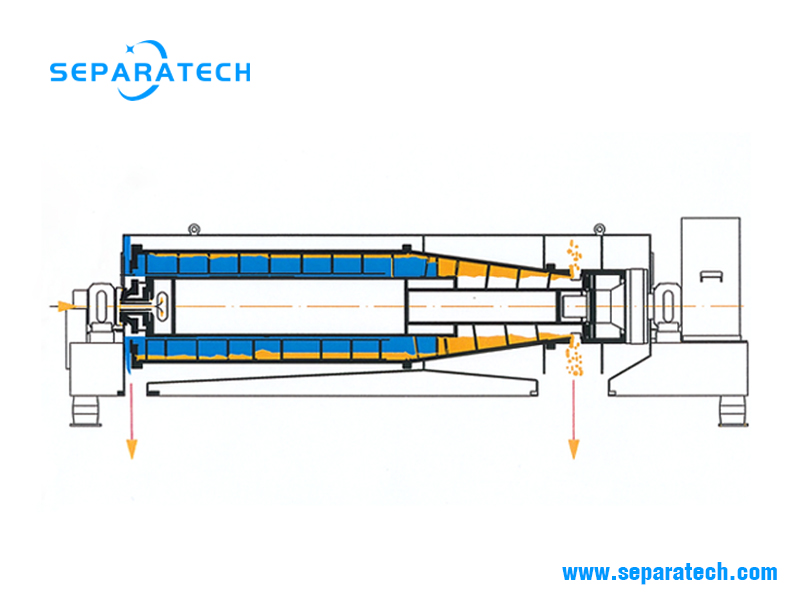
The operation of an industrial classifying decanter centrifuge relies on the precise balance between centrifugal sedimentation velocities and fluid transport mechanics. Instead of packing all solids against the bowl wall, the machine operates as a highly accurate wet classifier through the following synchronized mechanical stages:
- Precision Material Feed: The raw slurry containing a broad distribution of particle sizes is introduced coaxially via a stationary inlet pipe into the center of the rotating scroll hub. A specially designed feed distributor accelerates the suspension smoothly, matching the high rotating velocity of the solid bowl without disrupting the particle structures.
- Differential Hydrodynamic Sedimentation: Under a precisely calculated $G$-force matrix, the separation takes place inside the liquid pond. The larger, heavier particles (coarse fraction) sediment rapidly against the inner cylindrical-conical bowl wall due to their higher settling velocities. Concurrently, the smaller, ultra-fine particles (fine fraction) remain suspended in the liquid pool, escaping the drag forces of the solid sediment layer.
- Continuous Coarse Transport: An internal screw scroll conveyor, rotating coaxially inside the solid bowl at a highly sensitive differential speed (Δn), gently scrapes the settled coarse sediment off the bowl wall. The conveyor pushes these coarse solids up the conical beach zone for automated discharge through tungsten-carbide-protected ports.
- Fine Fraction Effluent Discharge: Concurrently, the clarified liquid containing the premium fine particle fraction flows in the opposite direction toward the large cylindrical end. It overflows over highly adjustable weir plates into the effluent casing, ready for immediate downstream processing or final product collection. This continuous separation ensures an incredibly sharp d50 cut point and eliminates particle cross-contamination.
Structural Blueprint and Technical Architecture
To endure the highly abrasive and corrosive environments common in industrial minerals and chemical processing, the Separatech classifying decanter centrifuge is built with heavy-duty structural metallurgy and advanced electronic controls:
- High-Tensile Duplex Stainless Steel Bowl: The solid rotating bowl assembly is manufactured from high-grade duplex stainless steel (such as SUS32205 or SUS316L) via premium centrifugal casting methods to meet rigorous high-grade duplex stainless steel standards. This guarantees zero structural distortion and extreme resistance to localized pitting corrosion under high centripetal acceleration.
- Maximum Abrasive Wear Armor: Because classification slurries often contain highly abrasive quartz, titanium dioxide, or mineral ores, all high-wear components—including the entire length of the scroll conveyor flights and the discharge nozzles—are fully armored with premium tungsten carbide tiles or thick cobalt-alloy hard-facing coatings.
- Smart Dual-Motor Variable Frequency Drive (VFD): Equipped with a highly advanced dual-motor VFD electronic matrix and a high-torque planetary gearbox. This state-of-the-art configuration allows plant operators to adjust both the bowl rotational speed and the conveyor differential speed independently with pinpoint real-time accuracy, adapting instantly to changes in feed concentration.
- Vibration-Isolated Pillow Blocks: The entire high-speed rotating mass is supported by top-tier, heavy-duty main bearings housed inside robust cast-iron housings. This structural design minimizes thermal expansion and ensures an ultra-low vibration profile during continuous 24/7 operations of classifying decanter centrifuge.
Strategic Advantages for Industrial Classifying Processes
Implementing a SEPARATECH classifying decanter centrifuge delivers significant operational and economic performance benefits over traditional gravity settling tanks or hydrocyclones:
- Exceptionally Sharp Separation Cut Point: Achieves highly precise micron-level particle classification, ensuring that the final fine fraction contains minimal oversize grit contamination.
- Elimination of Chemical Flocculants: Unlike dewatering systems, our wet classification process relies purely on advanced fluid dynamics and settling velocities to separate particles naturally, eliminating the high operational costs associated with polymer and flocculant dosages.
- Flexible Operating Flexibility: Operators can easily alter the d50 cut size mid-operation simply by adjusting the bowl speed or the liquid pond depth via the centralized control panel, minimizing plant downtime.
- High-Volume Continuous Throughput: Engineered to replace large footprint gravity classifiers, handling massive hourly slurry volumes within a highly compact structural envelope.
Critical Applications Across Global Mineral & Chemical Sectors
The high-precision classification capability of our classifying decanter centrifuge makes it indispensable across numerous demanding industrial manufacturing sectors:
- Kaolin Clay & Calcium Carbonate Processing: Ultra-fine classification of paper-coating grades of kaolin clay, and removing abrasive grit from Ground Calcium Carbonate (GCC) and Precipitated Calcium Carbonate (PCC) slurries.
- Mining & Metallurgical Tailings: Separation and classification of valuable minerals from tailings streams, and optimizing potash crystallization processes by removing fine salt fractions.
- Titanium Dioxide & Pigment Production: Precise particle size classification of wet chemical pigments to guarantee consistent color quality, hiding power, and optimal texture properties.
- Ceramics & Advanced Materials: Delivers flawless wet classification for high-purity silica, alumina, and industrial ceramic slurries, ensuring zero oversize grain contamination in the final mix.
Advanced Settlement Dynamics & Process Optimization
Maximizing the efficiency of a classifying decanter centrifuge requires a profound understanding of the internal settlement dynamics. By fine-tuning the hydraulic retention time within the solid bowl, smaller particles with lower settling velocities are given sufficient time to escape the coarse cake boundary, drastically reducing product loss in the coarse discharge stream. Additionally, managing the exact differential speed dictates how fast the coarse sediment is cleared from the drying beach, directly preventing torque overload. By manipulating these critical process variables through the integrated automated PLC interface, your plant operators can confidently manage varying feed densities while achieving superior particle classification and unmatched product consistency.
Furthermore, managing fluid shear stress inside the acceleration chamber of the classifying decanter centrifuge is paramount when processing shear-sensitive crystals or organic particulates. Excessive turbulence during the initial slurry feeding stage can unintentionally break fragile solid aggregates, altering the original particle size distribution and shifting the established d50 cut point. To mitigate this process risk, our advanced design utilizes smooth feed distributors and continuous inner-bowl hydrodynamics that accelerate the incoming feed smoothly. This specialized fluid management preserves particle structural integrity, preventing unwanted fines generation and securing flawless wet classification accuracy even under maximum operating capacities.
Custom Engineering of Classifying Decanter Centrifuge Systems
No two wet classification challenges share identical particle size distributions. SEPARATECH’s dedicated team of process engineers can fully customize the internal bowl geometry, cone beach angles, screw flight pitch, and wear-protection matrices to perfectly align with your specific material viscosity, slurry concentration, and desired micron cut point.
Contact SEPARATECH today to consult with our industrial separation specialists. We will provide a comprehensive engineering evaluation, laboratory pilot analysis data, and a fully optimized classifying decanter centrifuge quotation tailored to maximize your facility’s processing performance.