Screen Scroll Centrifuge
What is a Screen Scroll Centrifuge?
A screen scroll centrifuge (also widely recognized as a screen worm centrifuge or continuous filtering centrifuge) is a highly efficient, continuous-operation solid-liquid separation equipment. Engineered for heavy industrial dewatering applications, it combines the powerful mechanics of centrifugal sedimentation with advanced screen filtration.
The primary advantage of a screen scroll centrifuge lies in its ability to process slurries with high solid concentrations and coarse crystalline particles continuously, delivering exceptionally high throughput and superior cake dryness without interrupting the production cycle.
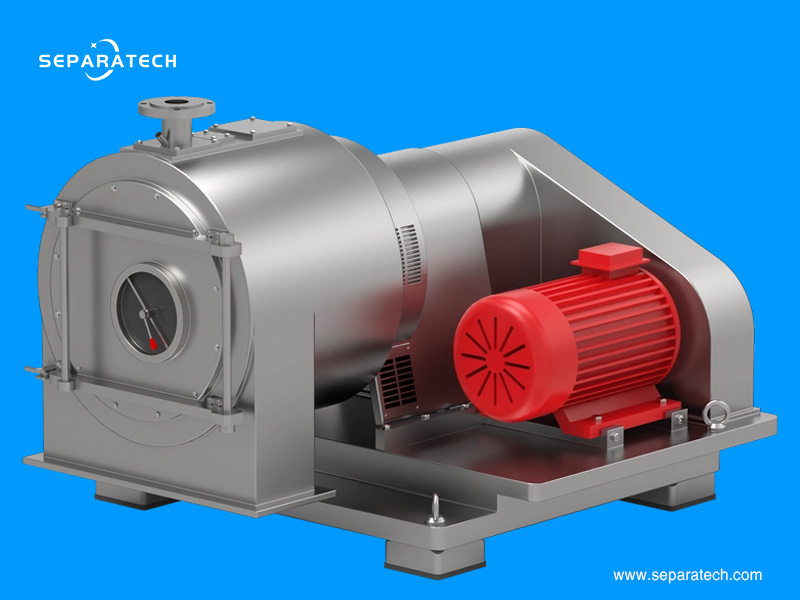
Screen Scroll Centrifuge Working Principle
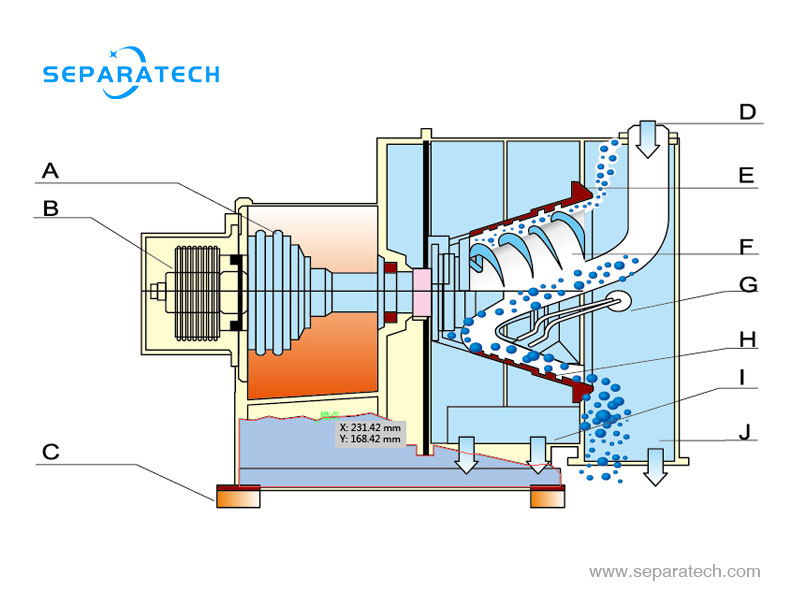
A: Gearbox
B: Belt
C: Damper
D: Feeding inlet
E: Bowl
F: Screw
G: Flushing inlet
H: Screen
I: Liquid outlet
J: Solids outlet
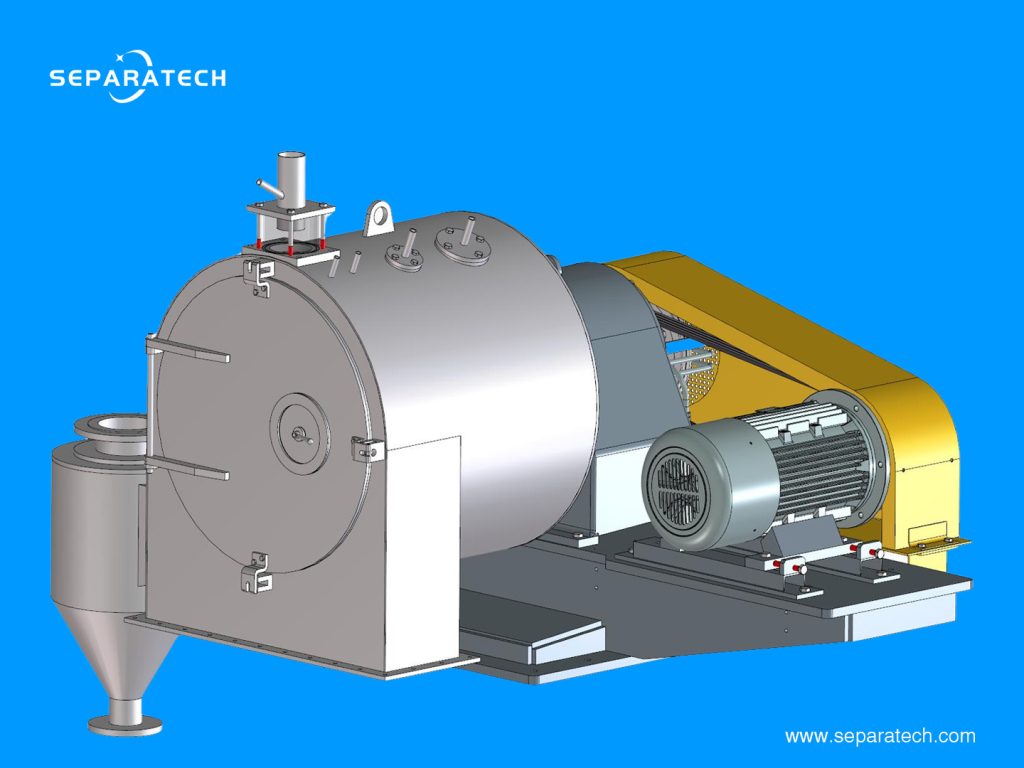
The horizontal screen scroll centrifuge is composed of a drive unit located in a bearing housing, the screen retaining basket, the screen element, the transport worm and the product housing enclosing the rotating parts.
The exceptional efficiency of the Separatech screen scroll centrifuge is driven by its synchronized dual-rotor mechanism. Inside the machine, a conical filtering basket and a concentric inner scroll (conveyor) rotate in the same direction but at a slight differential speed, which is precisely managed by an industrial-grade gearbox.
- Slurry Feeding: The feed slurry enters the narrow end of the conical basket through a stationary feed pipe.
- Centrifugal Filtration: As the slurry accelerates under immense G-force, it is thrown against the high-precision wedge wire screen. The liquid phase passes through the screen slots and is discharged as clarified filtrate.
- Continuous Discharging: Simultaneously, the solid crystal cake is retained on the screen surface. The inner scroll conveyor continuously pushes the solids toward the wider diameter end of the basket, where they are expelled seamlessly into the solids discharge hood.
Most solids will slide toward the largest diameter under the influence of centrifugal force, where they are discharged into the product housing over the open basket end. If the solids try to stick to the screening surface, the worm pushes them forward and if the solids try to slide out too quickly, the worm holds them inside the basket. The transport worm acts as a control mechanism by regulating the solids` sliding speed and retention time. If the coefficient of friction of the wet solids is low, the flights hold the solids back, and near the discharge end of the screen basket if the dewatered solids friction force is high against the screen, the worm will advance the solids to discharge.
Inside the basket and screen is a concentrically located worm where the flight tips are set at a clearance of 0.5 – 4 mm from the screen surface.
The solids/liquid mixture flows into the horizontal screen scroll centrifuge via a central feed pipe to the inside of the worm. The interior of the worm has a feed cone that preaccelerates the slurry and also distributes it uniformly onto the screening element inside the rotating basket.
These components make up the rotating wetted parts which are of single bearing design cantilevered from the drive housing. The worm rotates at a slightly different speed than the screen basket which results in uniform product acceleration and distribution. This makes the machine very insensitive to fluctuations in the feed concentration and other operating conditions.
The solids/liquid mixture enters the rotating components in the area of the smallest diameter and the majority of liquid is separated through the screen.
In this area the circumferential speed is lowest resulting in smaller power demand compared to cylindrical design machines for the same purpose.
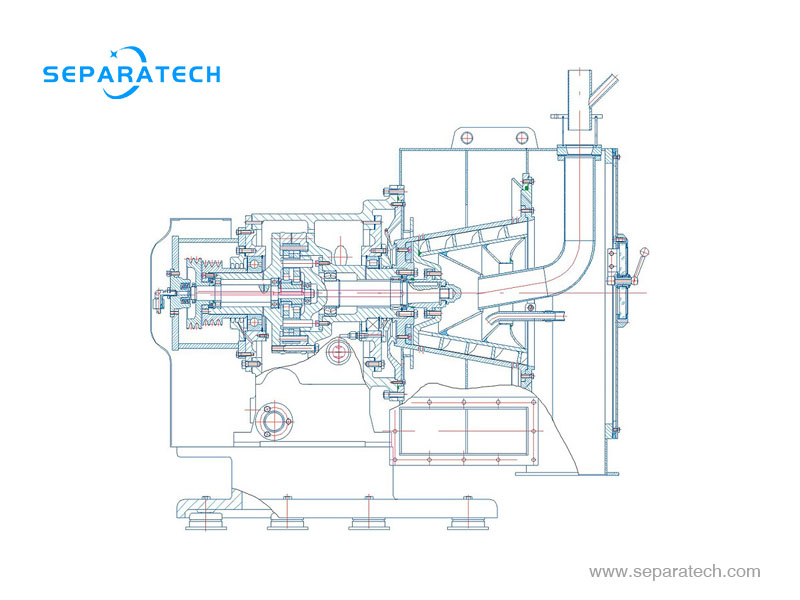
Technical parameters
| Type | H350 | H450 | H520 | H630 | H720 |
|---|---|---|---|---|---|
| Bowl diameter (mm) | 350 | 450 | 520 | 630 | 720 |
| Bowl length (mm) | 220 | 300 | 350 | 465 | 520 |
| Max. bowl speed (rpm) | 3000 | 2600 | 2000 | 1850 | 1650 |
| Max. G-force (g) | 1764 | 1702 | 1185 | 1205 | 1100 |
| Main Motor Power(KW) | 11 | 22 | 30 | 37 | 55 |
| Dimensions L×W×H(mm) | 1241×1265×1528 | 1400×2050×1450 | 1465×2135×1510 | 1810*1880*1720 | 2000*2300*1800 |
| Gross Weight(kg) | 990 | 2450 | 2715 | 2800 | 4000 |
Construction Material
All process contact parts can be manufactured in corrosion-resistant, austenitic steels, Hastelloy, nickel, titanium, etc. depending on the particular application. In all applications, proper wear protection is available for abrasive feed material.
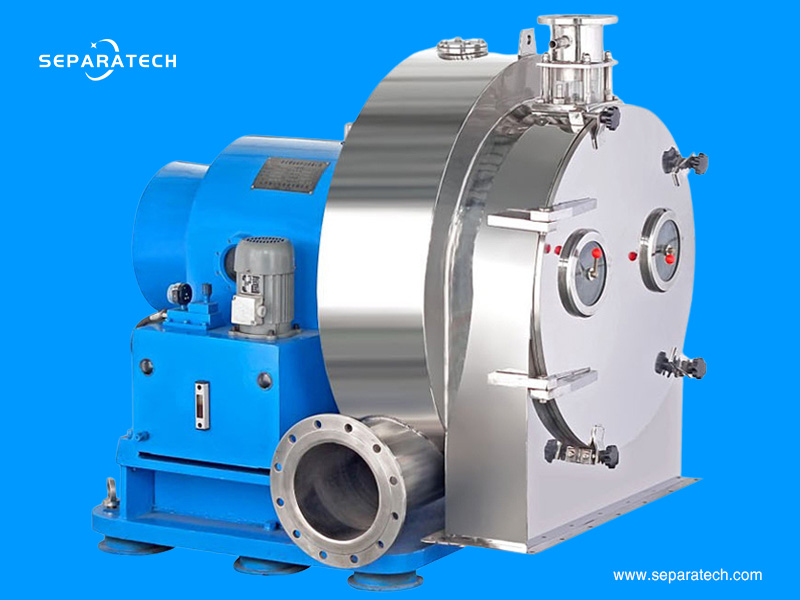
Core Advantages of SEPARATECH Screen Scroll Centrifuge
Continuous High-Throughput Operation: Eliminates the downtime associated with batch-type machines, ensuring a steady, uninterrupted flow for large-scale industrial lines.
Exceptional Cake Dryness: The combination of high centrifugal force and a progressive conical screen area ensures maximum moisture removal, significantly reducing subsequent thermal drying costs.
Intensive Cake Washing: Built-in, adjustable wash nozzles allow for thorough, uniform rinsing of the crystal bed to remove residual mother liquor and impurities, achieving high product purity.
Heavy-Duty & Wear-Resistant Construction: To handle highly abrasive materials, our scrolls are enhanced with tungsten carbide tiling or hard-facing, while the wedge wire screens are crafted from premium SS316L, Duplex steel, or Hastelloy.
CIP – cleaning: CIP capability is optional. Horizontal screen scroll centrifuge can be equipped with spray nozzles, so the machines are self-cleaning. For special requirements, the centrifuge can be provided with a CIP cleaning system. Included are special washing tubes, nozzles and if necessary, a slow speed drive to allow flooding of the product contact parts.
Typical Applications & Target Materials
Our continuous filtering solutions are engineered to handle complex crystalline structures without compromising particle integrity. To learn more about crystal lattice behaviors and mineral properties during mechanical processing, you can explore the resources provided by the International Union of Crystallography (IUCr).
- Salt Processing: High-capacity dewatering of Sodium Chloride (NaCl), Sodium Sulfate (
 ) and Ammonium Sulfate (
 ).
). - Potash Projects: Efficient separation and dewatering of Potassium Chloride (KCl) crystals at processing rates up to 30 Tn/h.
- New Energy Minerals: Superior dewatering and crystal washing for Lithium Carbonate (
 ) and Lithium Hydroxide (
 ) production lines.
 - Mining & Coal Dewatering: Fine coal slurry drying, mineral tailings recovery, and waste iron ore processing.
Adipic Acid
AH-Salt
Amino Acetic Acid
Ammonium Persulphate
Ammonium Phosphate
Ammonium Sulphate
Ammonium Thiosulphate
Anthracene
Aspirin
Bisphenol
Borax
Calcium Formiate
Carboxy-Methylcellulose
Celluloid Wool
Cellulose Wool
Chocolates (broken)
Citric Acid
Coal Slurry
Coffee Freeze Concentrate
Coffee Grounds
Copper Sulphate
Cotton Linters
Crystal Soda
Date Stones
Dimethylterephthalate
Dipterex
Disodium Phosphate
Finely chopped onions
Fungal Mycel
Glacial Acetic Acid
Glauber Salt
Greaves
Gypsum
Hops frome
Methylene Chloride
Ion Exchange Resin
Ironsulphate Heptahydrate
Lactose
Manganese Sulphate
Methylcellulose
Monosodiumphosphate
Naphtionate
Nuts (broken)
Nylon Chips
Oxalic Acid
Patent Soda
Pearl Polymerisate
Pentaerythrite
Plastic Granules
Plexiglas Beads
Polyethylene
Polymethacrylate
Polystyrene
Polyvinylalcohol
Potash
Potash Alum
Potash Solvent Residue
Potassium Bicarbonate
Potassium Bichromate
Potassium chloride
Potassium Monochromate
Potassium Pensulphate
Potassium Phosphate
Potassium Sulphate
PVA
PVC
Pyrazolene
Rock Salt
Rubber Regenerate
Silver Nitrate
Sodium Acetate
Sodium Bisulphite
Sodium Carbonate
Sodium Chlorate
Sodium Chloride
Sodium Formiate
Sodium Gluconate
Sodium Metaborate
Sodium Nitrate
Sodium Nitre
Sodium Perborate
Sodium Phosphate
Sodium Sulphate
Sodium Sulphite
Sodium Tetraborate
Sodium Thiosulphate
Tartaric Acid
Tin Sulphate
Trisodium Phosphate
Vegetables
Vegetable Extracts
Zinc Sulphate
Many others
Screen Scroll Centrifuge vs Pusher Centrifuge: How to Choose?
When designing a solid-liquid separation process, engineers frequently evaluate the screen scroll centrifuge vs pusher centrifuge. While both are continuous filtering centrifuges, they excel in different scenarios:
- Particle Size & Degradation: Pusher centrifuges handle fragile crystals gently because they use a reciprocating piston to push the cake. A screen scroll centrifuge utilizes a continuous scroll, which is ideal for robust, hard crystalline solids and minerals where slight particle attrition is acceptable.
- Feed Slurry Variations: The scroll-driven mechanism provides superior adaptability to fluctuations in feed concentration and solid loading, minimizing the risk of machine clogging or imbalance compared to pushers.
- Energy & Footprint: Our screen scroll centrifuges generally offer a more compact footprint and lower specific power consumption per ton of processed material, delivering a highly attractive Return on Investment (ROI).